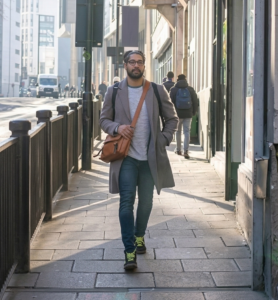
I was catching up with my friend, Tim, over coffee at Devilles. In the heart of Calgary’s Plus 15 infrastructure, the view offered a curious cross-section of modern professional life. Tim is a traditional Businessman, always impeccably dressed in custom-tailored suits. As I looked around the cafe, Tim was an anomaly different. Almost everyone else was draped in what could only be described as “high-end casual” at best.
The contrast was so bold it became our icebreaker. I had to ask him: “What do you think of today’s work fashion?”
The traditional definition of “corporate fashion” has undergone a profound change. The era of the rigid, charcoal-grey uniform and the starched collar hasn’t entirely disappeared, but it has been largely deconstructed. In 2026, the guiding principle seems to be Soft Power. Modern office wear is no longer about looking like a nameless cog in a machine; it’s about signalling competence through high-quality fabrics, thoughtful tailoring, and intentional comfort.
The “power suit” is fading, replaced by knit and sneakers. For women, this manifests as oversized blazers and wide-leg trousers in confort or wool blends. For men, the unstructured blazer is the new king offering the weightless feel of a cardigan with the visual authority of a jacket.
The traditional dress shirt is losing ground to high-gauge knitwear. The quarter-zip sweater has solidified its place as a 2026 staple professional enough for the boardroom, yet comfortable enough for a cross-country flight. Merino wool or silk-blend knit polos have replaced the stiff Oxford as the preferred layering piece, bringing a softer texture to the professional profile.
Jeans are no longer confined to “Casual Fridays,” but they’ve been upgraded. While frayed or light-wash styles remain too informal, dark-wash, “trouser-cut” denim has emerged as a legitimate professional option. When paired with a crisp poplin shirt and loafers, it mimics the silhouette of dress pants while offering the versatility of denim.
The boundary between athletic and professional footwear has almost entirely blurred. High-end, minimalist leather sneakers are now widely accepted, even in conservative sectors like law or finance. For those who aren’t ready to go full-sport, chunky loafers and Chelsea boots have largely replaced the traditional Oxford shoe.
Today, visible branding is considered a relic of the past. The corporate world has embraced “Stealth Wealth.” The focus is on tactile luxury suede, cashmere, and organic silk adding visual interest through texture rather than loud logos or patterns.
The evolution of workplace fashion reflects a fundamental shift in our perception of professionalism. We’ve moved away from “dressing to fit in” toward “dressing to function.” This leads to the inevitable question: Has the rise of remote and hybrid work caused this shift? As we returned to spaces and the Plus 15, we brought that demand for comfort with us, refusing to trade our well-being for a three-piece suit.
Today’s corporate style is about expressing individuality and showcasing competence through quality rather than conformity. Tim may still have his tailor on speed dial, but for the rest of the world, the office has finally loosened its tie.
When I ask Tim his option, he simple said he was raised to always look his best!
Your Friend
Danijel Slisko